Author: Paul Nesselroade

Ravensbrück and the Nature of Evil

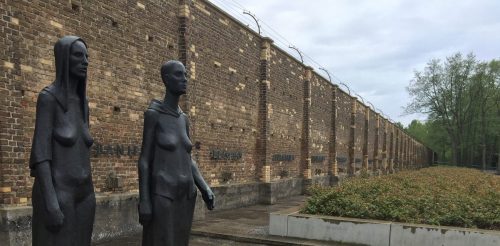
About an hour north on the Regional 1 train out of Berlin brings you to a beautiful German town called Fürstenberg an der Havel (Furstenberg, on the river Havel). Just a short distance to the northeast of Fürstenberg, a 3- to 4-kilometer walk from the train station around a swelling in the Havel called Lake Schwedtsee, sits Ravensbrück Concentration Camp. Ravensbrück was distinct as the only major German-based concentration camp set up exclusively for women prisoners (near the end of the war, the camp was expanded to include a men’s section). In all other respects, it was a typical Nazi

Read More »

The Topography of Terror and an Unwelcome Stirring

Just one city block down from Checkpoint Charlie on Niederkirchnerstraβe sits the Topography of Terror, a museum intentionally positioned at the site of the former headquarters for various notorious Nazi organizations such as the Gestapo and the Einsatzgruppen (a contingent of the Schutzstaffel, or SS; these were the specialized killing squads that ran riot behind the advancing German lines in the conquered territories of the East, rounding up and killing in mass Jews, Romani and Sinti peoples, as well as other perceived political or biological threats). Running along the front of the main museum building still stands the longest extant

Read More »

Sir Francis Galton

(Essay found in Nesselroade & Grimm, 2019; pgs. 596 – 597) Francis Galton (1822–1911) is credited with developing the concepts of correlation and regression, although his understudy, Karl Pearson, was responsible for many of the mathematical underpinnings of correlation. Galton led a full and varied life. Born into a wealthy English family, he was afforded the luxury of indulging his scientific curiosities. In the mid-1800s, European explorers were mapping the interior of Africa. Perhaps inspired by the travels of his prodigious cousin, Charles Darwin, Galton departed for Africa at the age of 28. His maps of unknown regions of Africa

Read More »

Karl Pearson

(Essay found in Nesselroade & Grimm, 2019; pgs. 532 – 533) Karl Pearson was born in London in 1857, two years before Darwin published Origin of Species, a work that would shape Pearson’s entire academic life. It is reasonable to consider Pearson the father of modern statistics. Pearson completed the work on correlation that Galton had started, arriving at the coefficient that bears his name (the Pearson product-moment correlation). He subsequently devised formulas for computing correlations for variables that are noncontinuous (see Chapter 18). Pearson is responsible for many of the concepts and statistical terms that were introduced earlier in

Read More »

John Wilder Tukey

(Essay found in Nesselroade & Grimm, 2019; pg. 404) John Tukey (1915–2000) was born in New Bedford, Massachusetts. He was homeschooled by his educator parents who responded to his numerous questions not with direct answers but with clues and follow-up questions designed to help him solve his own problems (McCullagh, 2003). This philosophy produced a remarkable student, culminating in two degrees from Brown University in Chemistry and a Ph.D. in mathematics from Princeton in 1939, where he was asked to stay-on as a professor upon graduation. He stayed at Princeton for his entire career. During World War II he decided

Read More »

Sir Ronald Fisher

(Essay found in Nesselroade & Grimm, 2019; pgs. 379 – 380) Ronald Fisher (1890–1962) was born in England. He is considered a child prodigy. His daughter and biographer offers the following story. At about age three when he had been set up in his high chair for breakfast, he asked: “What is a half of a half?” His nurse answered that it was a quarter. After a pause, he asked, “And what’s a half of a quarter?” She told him that it was an eighth. There was a longer pause before he asked again, “What’s a half of an eighth,

Read More »

William Gosset

(Essay found in Nesselroade & Grimm, 2019; pgs. 267-268) William Gosset (1876–1937) developed the t distribution as well as the independent- and dependent-samples t tests. After receiving a degree in chemistry and mathematics from Oxford, Gosset was hired by the Guinness brewery in Dublin in 1899. Around the turn of the century, many companies, especially in the agricultural industry, attempted to apply a scientific approach to product development. A typical research question would have been, “Which fertilizer will produce the largest corn yield?” or “What is the best temperature to brew ale so as to maximize its shelf life?” Until

Read More »

Thomas Bayes and Bayesianism

(Essay found in Nesselroade & Grimm, 2019; pg. 186) Thomas Bayes (1701 – 1761) was a nonconformist (a term used for those who had problems with the Church of England) English cleric, statistician, and philosopher (Bellhouse, 2001). Although his interests were broad and his writings ranging from theology to a defense of Newton’s ideas regarding calculus, he is most well-known for a posthumously published paper by a friend in which he formulated a specific case of the theorem that now bears his name (Bayes’ Theorem; see section 6.9). His theorem solved the problem of inverse probability (also known as the,

Read More »

Abraham De Moivre and the History of the Normal Curve

(Essay found in Nesselroade & Grimm, 2019; pgs. 135-136) The discovery of the normal curve is usually attributed to Abraham De Moivre (1667 – 1754); being traced to a publication of his from 1733 (De Moivre, 1738; English Translation). He was a friend of people like Edmond Halley (of Halley’s Comet fame) and Sir Isaac Newton and was held in high esteem by the intellectual class of his time. Apparently, Newton occasionally replied to questions with, “Ask Mr. De Moivre, he knows all that better than I do” (Walker, 1934, p. 322). De Moivre’s discovery grew out of his interest

Read More »

Rensis Likert

(Essay found in Nesselroade & Grimm, 2019; pgs. 39 – 40) Use the scale below to respond to the following statement: I enjoy studying statistics. ○ ○ ○ ○ ○ 1 2 3 4 5 Strongly Disagree Disagree Neither Disagree nor Agree Agree Strongly Agree If we have ever had to respond to a question in this manner, we can thank the social scientist, Rensis Likert. Likert, born in 1903 in Cheyenne, Wyoming, first began his undergraduate studies in 1922 in civil engineering, but then soon discovered that he preferred to study people instead of inanimate objects (Faculty History Project,

Read More »